

End-to-End Advisory Services for Setting Up a New School in India.
RGF School Consultancy end-to-end consulting services for establishing K–12 schools across India. From "Concept to Launch, " RGF guides clients through every aspect of the school setup process, providing valuable insights into operational challenges encountered throughout the project cycle. We meticulously safeguard the interests of promoters across the entire spectrum, commencing with project planning, legal framework, branding, marketing, admissions, recruitment, administration framework, staff training, and affiliations. Our dedicated school consultants excels in successfully establishing CBSE, ICSE, IB,IGCSE . State, National & International school projects.
Our school consultants have considerable experience navigating all the distinct steps involved in setting up a new school including drafting sustainable school concepts as well as a detailed project report. Our school consultants understand the intricacy of details and level of planning required to launch a new school. Hence we have developed skills and cultivated resources to create access to the right talent, plan school facilities, draft master plans, decide upon suitable architecture and design for schools building and interiors, establish curriculum, create policies to ultimately deliver a world-class educational experience.
Establishing a school requires meticulous planning across every critical aspect, including location, budget, services, board affiliation, vision, core team formation, and syllabus development. To differentiate the school and establish a strong presence in the education sector, it is essential to have effective marketing, PR, admission strategies, pre-launch campaigns, audience engagement, and a well-planned opening ceremony. School consulting services are tailored to meet the specific requirements of each project, while considering the diverse needs of key stakeholders and decision-makers. The ultimate objective is to transform the school into a distinctive, impactful, and forward-thinking institution that stands out as a changemaker in the education industry.

RGF School Consultancy Services brings extensive experience, expertise, and proven success in establishing schools and educational institutions across India. We provide end-to-end guidance throughout the school setup journey, from planning and legal frameworks to branding, marketing, admissions, recruitment, administration, academic planning, staff training, and board affiliations.
Our team specialises in supporting the successful establishment of CBSE, ICSE, IB, and IGCSE, Cambridge, State, National & International school projects, helping promoters anticipate challenges, make informed decisions, and protect their interests throughout the project cycle. With specialised expertise in the foundation and development of new schools, we help transform concepts into sustainable educational communities and successful centres of learning.
From location, budget, vision, board selection, core team, and curriculum to marketing, PR, pre-launch campaigns, admissions, and school launch, every element requires careful planning and strategic execution. Our mission is simple: to help your school stand apart, build a strong identity, and emerge as a distinctive changemaker in the education sector.
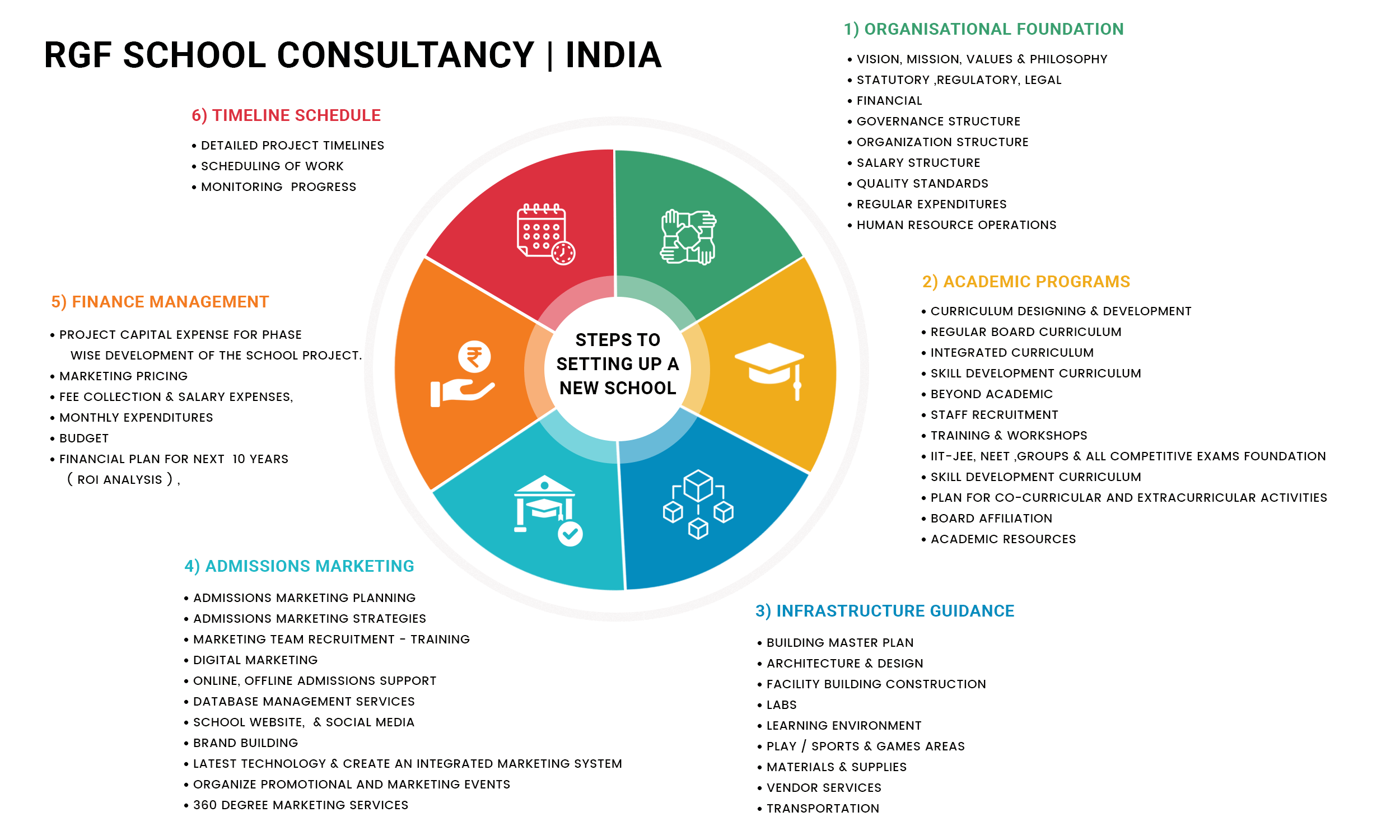
Before starting a school, every school entrepreneur or promoter must have complete clarity about the institution’s Vision, Mission, Educational Concept, and Educational Philosophy. These foundational elements define the school’s identity, guide every major decision, and create a strong, consistent direction for its long-term growth.
Leading and # 1 Specialist School Educational Consultancy in India
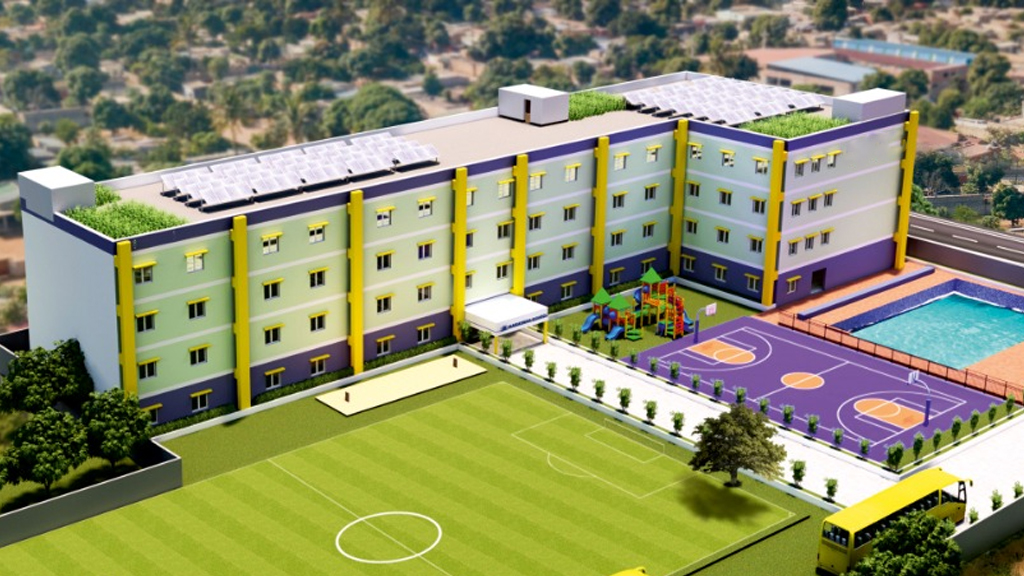
The first and most crucial step in establishing a new school in India is to appoint the right school consultant or experienced advisory team. A competent consultant provides strategic direction, supports critical decision-making, minimises project risks, and ensures that the school project is planned on a strong and sustainable foundation.
For establishing a successful school in India, this phase is of paramount importance. Comprehensive Market Research, Feasibility Assessment, and Project Planning provide promoters with the critical insights required to make informed decisions and establish a clear roadmap for the project. RGF evaluates the key market, academic, operational, financial, and infrastructure parameters to ensure a balanced, viable, and sustainable school development strategy.
In India, a school can generally be established under the aegis of a Society, Trust, or Section 8 Company, subject to the applicable education regulations, state laws, and affiliation requirements. The choice of legal structure depends on the founders’ objectives, governance preferences, funding model, and long-term vision for the institution.
A school may be established through a registered Society or Trust, which are commonly used structures for educational institutions in India.
A school can also be established through a Section 8 Company incorporated under the Companies Act, 2013. This structure is particularly suitable for founders seeking a formal corporate governance framework for a not-for-profit educational organisation.
Following the Feasibility Study, Market Assessment, and ROI Analysis, and supported by detailed planning insights from our school consulting team, the project moves into the crucial stage of land identification, evaluation, and finalization.
Selecting the right site is one of the most important decisions in establishing a successful school. The land must not only meet the applicable educational board and government requirements, but should also support the school’s academic vision, infrastructure plan, accessibility, financial model, and long-term expansion strategy. Where required, the promoter must also obtain the necessary permissions for Change of Land Use (CLU) / conversion of land use for educational or institutional purposes from the competent authority. The minimum land requirement for a school depends on several factors, including the affiliating board, state regulations, location category, applicable development rules, and proposed school infrastructure.
For CBSE schools, the land requirement for a new school varies between 1600 sqm and 6000 sqm, with a minimum requirement that differs between urban and rural areas.
In contrast, ICSE schools require a minimum land area of 2000 sqm to initiate the establishment.
For schools following international curricula such as IB and Cambridge, the minimum land requirement is determined by the norms set by the respective state.

Once the land is finalized, the next step is to appoint an experienced school architect and multidisciplinary design team to develop a functional, safe, compliant, and future-ready campus. The team prepares the master plan, architectural and technical designs, and statutory drawings required for approvals, ensuring alignment with the school’s academic model, capacity, operational needs, safety standards, and future expansion plans. Architectural planning and project funding can proceed concurrently to optimize the overall project timeline.
The school architecture team will develop the Campus Master Plan and Operational Floor Plans, incorporating inputs from the consulting team to ensure efficient space utilization, functional planning, and regulatory compliance. Once approved, the plans will be submitted to the relevant government authorities for statutory approvals. In parallel, the architectural team will develop the Building Elevations, Tender Documents, and construction-related drawings. During the initial three months, the client will work closely with the design team to finalize the Building Concept, Architectural Design, and Elevations, establishing a clear foundation for the subsequent construction phase.
Once the Master Plan, Building Placement, Area Statement, and Facility Plan are finalized, the school architecture team works closely with the client to prepare and submit the required architectural and engineering drawings to the concerned authorities for approval. Upon obtaining the applicable permissions, construction activities can commence as per the approved plans. Simultaneously, the architectural team develops and presents the Building Elevation and Architectural Concept, ensuring that the proposed campus reflects the school’s vision, functionality, identity, and statutory requirements.
Following client approval and financial closure, tender documents, BOQs, and specifications are prepared, and qualified contractors are invited to bid. After contractor appointment, civil and structural works begin with site mobilization and workforce deployment. A dedicated Site Engineering & PMC team oversees project coordination, quality control, cost management, safety, reporting, and timely execution, ensuring the project progresses as per the approved design and schedule.
Once the designs and plans receive the necessary approvals from the concerned authorities, construction activities can commence. The promoter should aim to complete the school building, landscaping, interiors, furniture, fixtures, and essential infrastructure approximately 3–4 months before the commencement of the academic session. Establishing a clear construction completion deadline is critical, as it provides the project with approximately 100–120 days for admissions, marketing, staff recruitment, operational preparation, and final infrastructure readiness. This lead time enables the school to present a fully developed campus to prospective parents and ensures a smooth and well-coordinated launch of the new school.
Establishing a new K-12 school in India typically takes 10 to 24 months, covering planning, feasibility, construction, recruitment, academics, statutory compliance, and launch. The timeline may vary based on the project scale, location, approvals, construction, board requirements, and planned facilities. A well-structured, phase-wise approach ensures a smooth and timely school launch.
The school’s branding and admissions marketing journey begins from Day 0 and is executed through a structured 180–200 day roadmap. The initial four months focus on developing the school’s complete brand identity and strategic marketing foundation, creating the essential assets required to establish market presence, build credibility, and drive admissions.
The process integrates brand strategy, positioning, creative development, digital marketing, market activation, and admissions planning—covering everything from finalizing the school name and logo to developing the website, brochure, communication materials, campaigns, and other brand collaterals. The phased roadmap concludes with admission-team training and handling protocols, ensuring that the school is fully equipped to convert market visibility into enquiries, admissions, and long-term parent relationships.
Once the school’s branding and positioning are finalized, the recruitment process should begin as part of a structured 6–7 month staffing plan. The recruitment strategy prioritizes critical leadership and administrative positions, beginning with the Principal/School Head, followed by key functions such as Accounts, Admissions, Administration, and Operations. Teaching staff should generally be recruited and onboarded 2–3 months before the commencement of the academic session, allowing sufficient time for orientation, training, curriculum planning, lesson preparation, and team integration before the school opens.
Staff onboarding is conducted in phases, aligned with project timelines to ensure the Admissions Office and key administrative functions are operationally ready. Simultaneously, SOPs, reporting systems, ERP, HR policies, and staff management frameworks are established, with the team trained to ensure smooth, compliant, and efficient school operations.
The Admissions Office is established approximately 6–7 months before the inaugural academic session, with the recruitment of admissions and administrative staff, finalization of accounting and fee systems, completion of branding, and commencement of outdoor marketing. The campus is prepared for parent visits and enrolment, while interiors for the administration, reception, admissions, classrooms, and activity areas are completed to ensure operational readiness.
Promotional activities begin approximately 5 months before the academic session to build awareness, generate enquiries, and increase prospective parent footfall. A focused 3–4 month marketing campaign is planned and executed, covering budgeting, admissions team setup, staff training, and enquiry handling. Collaboration with PR, digital marketing, and media partners ensures wider visibility and a successful school launch.
Academic planning, curriculum finalization, and teacher training commence approximately 3 months before the start of the academic session, aligned with the recruitment of the core teaching team. The training focuses on lesson planning, classroom management, parent communication, curriculum delivery, and effective implementation of the school’s academic vision, ensuring the faculty is fully prepared for the successful launch of the school.
The school affiliation process in India involves a series of regulatory and compliance steps to ensure that the institution meets the prescribed standards, infrastructure requirements, academic norms, and operational criteria of the respective education board. The process may vary depending on the chosen board, such as CBSE, CISCE (ICSE), IGCSE, IB or the respective State Board, and generally includes obtaining the required permissions, completing statutory compliances, preparing documentation, and fulfilling affiliation requirements before commencing operations.
Opening a school in India requires obtaining various statutory documents, permissions, registrations, and licenses to ensure compliance with applicable legal, safety, infrastructure, and educational requirements. The exact requirements may vary depending on the state, school category, and education board (CBSE, CISCE, IGCSE, IB or State Board). The following is a general list of documents and approvals commonly required for establishing and operating a school.
The school launch encompasses Parent Orientation and a professionally organized Launch Event, ensuring clear communication, parent engagement, and a strong community presence. All branding, admissions, academic, operational, and marketing efforts culminate in the successful and timely commencement of the school in line with the targeted academic session.
YES, Team RGF is equipped to deliver services to prospective clients across India. The RGF team has experience in delivering services globally.
Language, State are not any barriers for new school setup. Collaborations are a vital part of what we do.
No. You can start a school by getting necessary permissions from the state education department. After the school is opened you can apply for affiliation which requires information about your school operation. For learning everything about Starting a school look at our blog post How to start a school in India?
Yes, the school running in a building held on lease for at least 30 years can get CBSE affiliation, it should be located on a part of land which is also owned by the Trust/Society or the school or held on lease for at least 30 years and the area of the land must be 2 acres including the building and the playground. The minimum land area may vary with the region of location of the school. For the school 's affiliation to the CBSE clear directions have been given regarding the school property in CBSE affiliation by laws Chapter II Norms of Affiliation.
The Trust/Society running a school cannot have members of a family in a majority (more than 50 per cent). The non –proprietary affidavit of the Trust/Society should have a declaration made by the Chairman about the number of mutually related members. Try that the number of related members be as less as possible in the school governing board or the school management committee also.
Yes, the school running in a building held on lease for at least 30 years can get CBSE affiliation, it should be located on a part of land which is also owned by the Trust/Society or the school or held on lease for at least 30 years and the area of the land must be 2 acres including the building and the playground. The minimum land area may vary with the region of location of the school. For the school's affiliation to the CBSE clear directions have been given regarding the school property in CBSE affiliation by laws Chapter II Norms of Affiliation.
Yes, State board recognition is necessary for getting affiliated to any board that include CBSE and ICSE. The state education department also needs to issue an NOC stating that it has no objection regarding your school’s affiliation to the CBSE/CISCE. For complete details about getting your school affiliated to CBSE or ICSE refer to our blog posts How to Start a School and get CBSE affiliation? or How to start a school and get ICSE affiliation?
What if it is lesser than the state directed amount? The salaries you pay to the teachers and staff of your school may be less than the state requirements but there must be an EPF registration in every case. The variation is granted as the cost of living differs from region to region but there must be transparency in the bank statements and there must be no financial irregularity. Complete financial documentation is a must.
The permissions and related documents that are required for starting a new school in India are—
If you have an adequately qualified serving Principal for your school you need not appoint a new Principal. Same applies in case of teachers. The qualification of teachers and principles are provided in Chapter IX of CBSE affiliation Bye laws. Appropriately qualified school Principal and teachers for schools aspiring for CBSE, ICSE or international Board Affiliation can be hired through online school jobs portal rgfedu.com
The land and infrastructure requirements to start CBSE, IGCSE/Cambridge, ICSE and IB Schools in India are defined by the respective boards and vary with nature of accommodation, capacity, terrain, and geography. International organizations dwell upon the dimensions relatively lesser than CBSE or ICSE, nonetheless, they mandate a complete learning environment in every respect and can accommodate not only the given number of children but also the pedagogical activities, movements, and interactions. CBSE, ICSE or State board schools can also run international programs by provisioning appropriate infrastructure. Specific requirements have been detailed in the following articles –


 How to Increase School Admissions?